
On OKE, which documented ingress controller reads Ingress resources and programs an OCI flexible load balancer, adding Pods as backends on VCN-native clusters or nodes (with NodePort Services) on flannel clusters?
Select an answer to reveal the explanation.
Short Explanation
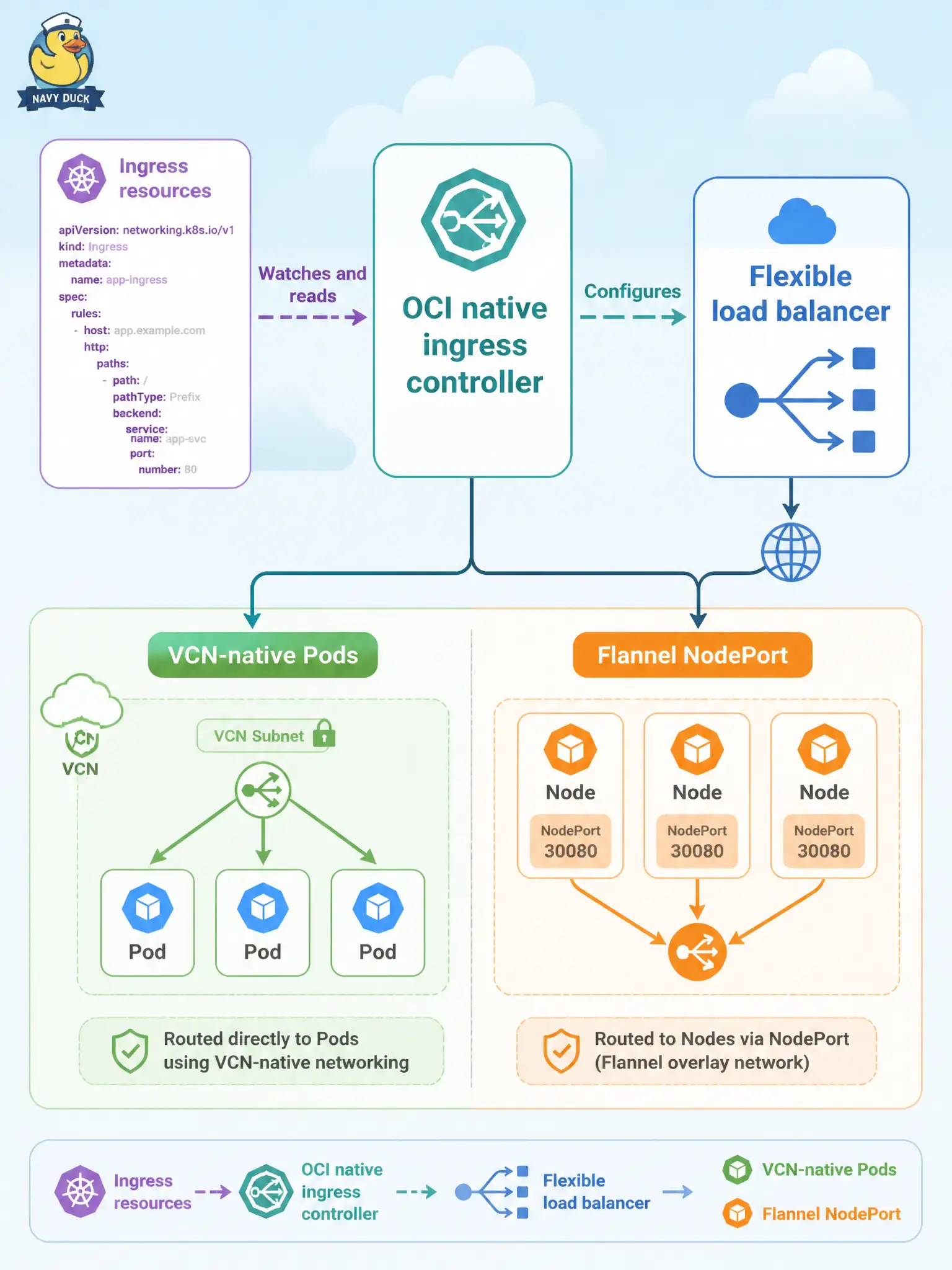
OKE docs point at the OCI native ingress controller: it watches Ingress objects and drives an OCI flexible load balancer. VCN-native clusters can backend Pods directly; flannel paths use nodes and expect NodePort Services. Not an Istio or Service Mesh syllabus item.
Full Explanation
On OKE, the documented ingress controller that reads Ingress resources and programs an OCI flexible load balancer is the OCI native ingress controller (enhanced-cluster add-on or Helm). On VCN-native clusters it can add Pods directly as backends; on flannel clusters it commonly targets nodes with NodePort Services. That pairing is what OKE documentation points teams to for LB-backed Ingress. Making Istio’s ingress gateway the required OKE default for all clusters overstates mesh as mandatory when the native controller is the platform-documented path for OCI LB integration. OCI Service Mesh sidecars focus on service-to-service policy and identity; they are not the primary object that programs flexible load balancer backends from Ingress rules. Installing only Traefik by deleting the Kubernetes API server is nonsensical and destroys the control plane. Exam caveat: cluster networking mode (VCN-native versus flannel) changes backend shape—Pods versus node/NodePort—so copy the pattern that matches your cluster, not a blog for the other mode. Operational check: install/enable the OCI native ingress controller, apply an Ingress, and verify an OCI flexible LB appears with the expected backend type for your CNI mode.