
Residents must reach a public recreation-registration API on OKE through an OCI load balancer. Which developer-facing Kubernetes object asks OKE to provision and wire that balancer to the selected Pods?
Select an answer to reveal the explanation.
Short Explanation
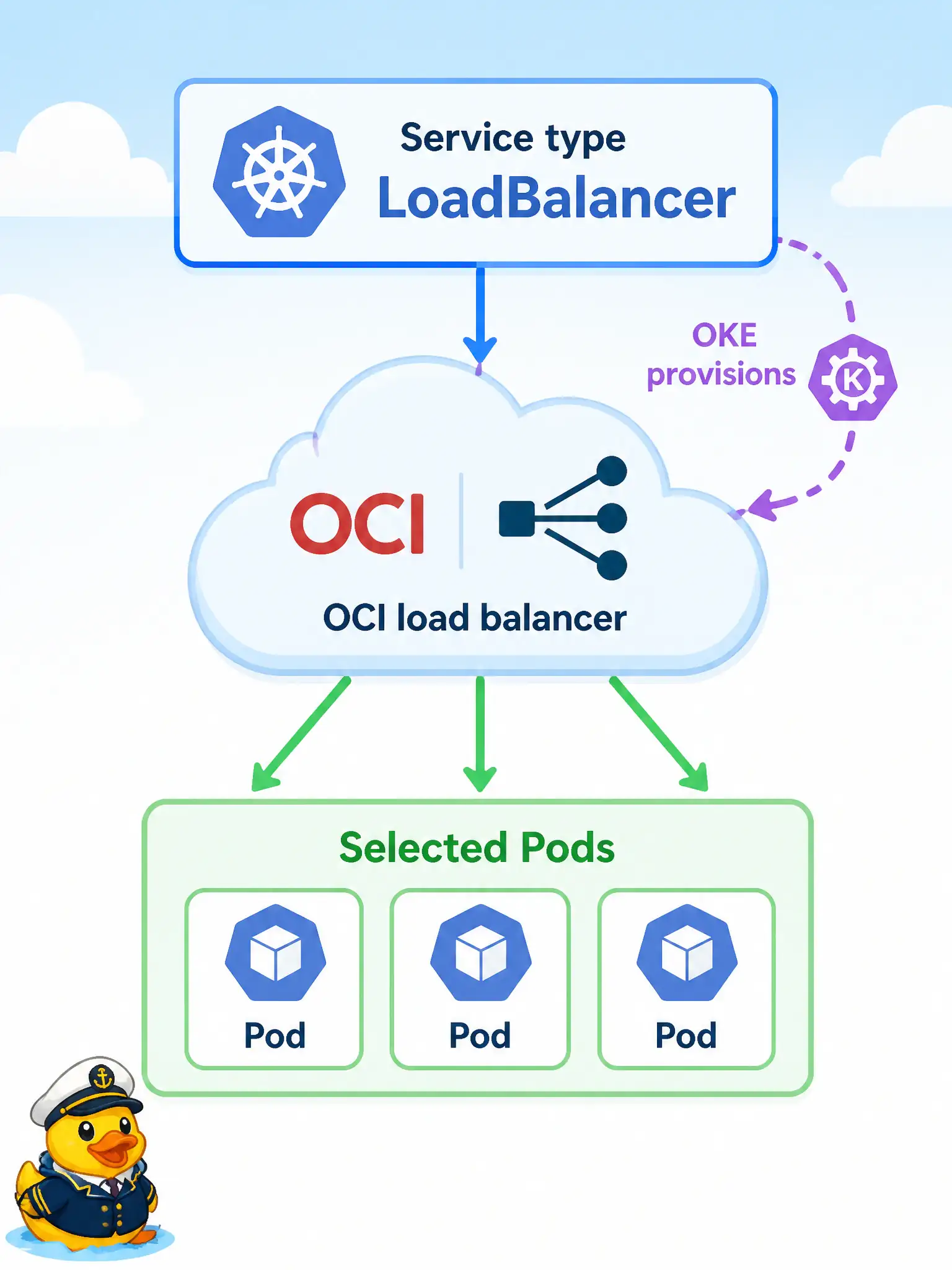
On OKE, type LoadBalancer on a Service is how you ask the platform for an OCI load balancer in front of your Pods. The cluster wires it up—you are not sitting an Architect landing-zone LB exam.
Full Explanation
Residents reaching a public recreation-registration API through an OCI load balancer is expressed on OKE with a Service of type LoadBalancer. That developer-facing object asks the cloud controller to provision and wire an OCI load balancer to the Pods selected by the Service; annotations can choose load balancer versus network load balancer behavior as OKE documents. You are not expected to design a tenancy hub-and-spoke load-balancer farm as the core skill for this item—the Kubernetes Service is the lever that ties platform networking to Ready backends. A ConfigMap named loadbalancer with no Service object stores arbitrary data only and provisions no balancer and no backends. A CronJob that runs oci lb create on a schedule without a Service bypasses integrated wiring of backends to Ready Pods and fights the control plane with unmanaged infrastructure. Exam caveat: the load balancer is only as healthy as selector matches and readiness—provisioning can succeed while public traffic fails if endpoints are empty or probes fail. Operational check: apply the LoadBalancer Service, wait for an EXTERNAL-IP, confirm OCI shows backends corresponding to Ready Pods, and test public access to the registration API.