
On a city developer workstation, which component actually creates the isolated process when someone runs a docker command?
Select an answer to reveal the explanation.
Short Explanation
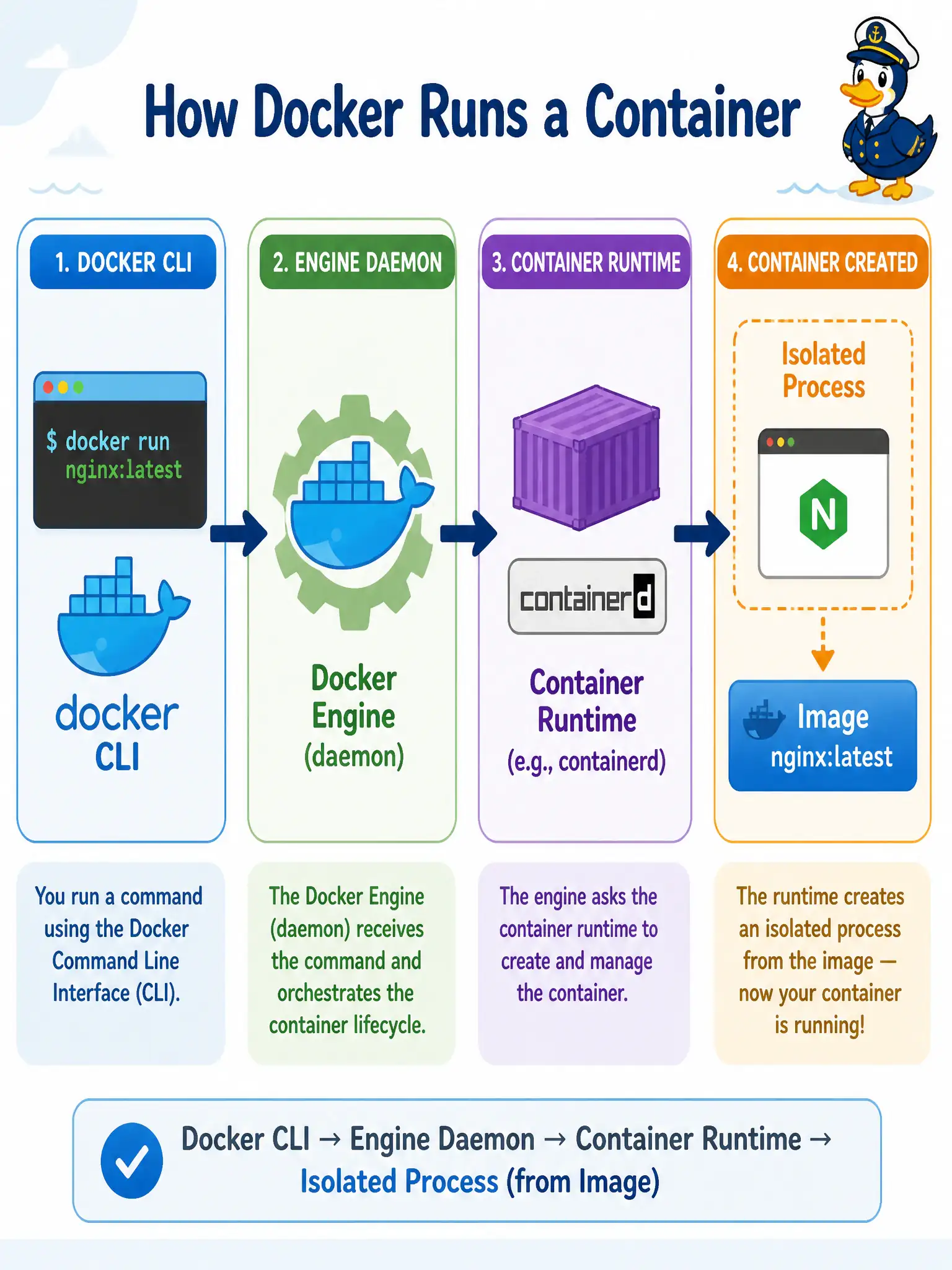
The CLI is the receptionist taking your order; the Engine daemon is the kitchen manager; the runtime is the cook who actually starts the process. Knowing who does what avoids blaming the wrong layer when something fails.
Full Explanation
On a city developer workstation, the Docker CLI is only the human and tooling front end that accepts docker commands and talks to a long-running Engine. The Engine daemon owns image pulls, container create/start/stop bookkeeping, and networking setup for the municipal workload under test. When you ask to run a container, the daemon asks a container runtime to create the isolated process from an image—namespaces, cgroups, and the writable layer land at that runtime handoff. Knowing CLI versus Engine versus runtime keeps troubleshooting honest: a socket error to the daemon is not an application bug, and a runtime start failure is not a registry outage.
An IDE Dockerfile parser may highlight syntax, but it never replaces the daemon as the component that creates isolated processes. The CLI alone does not fork containers without an Engine (or compatible engine) behind it. A registry mirror caches and serves image blobs; tagging or mirroring content does not start processes on the laptop.
Exam caveat: the exam expects professional role clarity among CLI, Engine, and runtime—not a deep dive into containerd or runc source trees or every OCI runtime flag. Operational check: if docker run fails with a cannot-connect-to-daemon error, verify the Engine service is running and the CLI socket path is correct before debugging the city’s application code or Dockerfile instructions.